LESER Update Optimization through simulation
LES_NL-Header-1920x560
  • Home
  • Optimization through simulation

LESER researches valve behavior under inlet pressure loss to assess valve dynamics.

Flawless safety valve operation is an essential requirement in the process industry in order to protect people, the environment and the industry. Insufficient stability in valve operation can have severe consequences: from reduced downstream mass flow through to mechanical damage to the valve or the adjacent piping. LESER is currently investigating how inlet pressure loss in the upstream piping impacts valve stability – and the findings are eye-opening.
Standard criterion with limitations

The current standard for inlet line sizing is based on the so-called 3% criterion: According to DIN EN ISO 4126-9, AD 2000-Data Sheet A2 and API 520 Part II, an inlet pressure drop not to exceed 3% is considered acceptable under safety criteria. However, recent research at LESER suggests that this blanket approach is not sufficient to reliably predict instability.
International standards committees and research initiatives are discussing potential alternative assessment methods. These include the concept of a critical inlet piping length accounting for the connected system’s specific geometry and dynamic properties.

Instabilities in the opening stage: A question of pressure waves

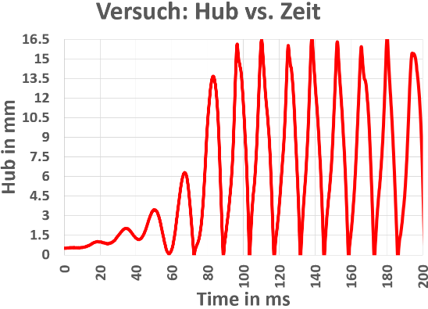
LESER’s experimental analyses show that valve instability often occurs at the early opening stage. This results in an escalating repetitive disc behaviour – a vibratory effect caused by pressure waves in the inlet line (see graphic above).
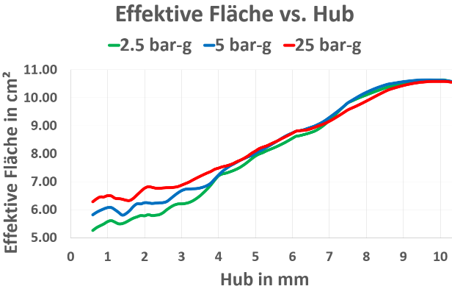
These waves are generated when the safety valve opens abruptly, and run backwards along the line, changing the forces that act on the valve disc and potentially leading to unstable behavior. LESER uses its own simulation software to study these complex dynamic phenomena. The software calculates the fluid force acting on the valve disc while accounting for the pressure waves. This enables a realistic simulation of the valve opening phase. One result of the numerical assessment is the so-called “effective surface”, a value that does not express a geometric quantity but a conceptual parameter depending on lift and pressure. It not only accounts for the interior valve contour but also for the inlet line geometry and the valve lift (refer to graphic below). LESER has successfully integrated this parameter with the simulation, establishing a more sophisticated method for modeling the fluid force while accelerating the time-consuming valve simulation process.
This revealed that the pressure under the valve disc drops during the opening movement while the pressure in the vessel remains more or less constant. Therefore the effective surface is defined as the ratio between the fluid force as determined by the simulation, and the actual pressure underneath the disc. Combining this with the pressure occurring at the interface between the inlet line and the valve allows a realistic assessment of the valve dynamics.

Can simulation replace testing?

The results of this research suggest that detailed simulation provides a sound method to supplement the blanket application of the 3% criterion. At the same time it opens up new pathways towards optimizing inlet lines and valve designs. While real-life test data remains indispensable, simulation tools can make a substantial contribution to a safe and economical design of safety valve systems in the future – further enhancing plant and operational safety.
“Our investigations illustrate how crucial a differentiated assessment of supply conditions is,” says Thomas Raeder, Manager Verification, Validation & Research at LESER’s Technical Department. “Instead of relying exclusively on the conventional criteria prescribed by standards, a combination of precision metrology and simulation-based analytics opens up new perspectives in ensuring stable, reliable valve behavior even under demanding conditions,” says the physicist, summing up his findings.
Vibration. Escalating repetitive disc movement.
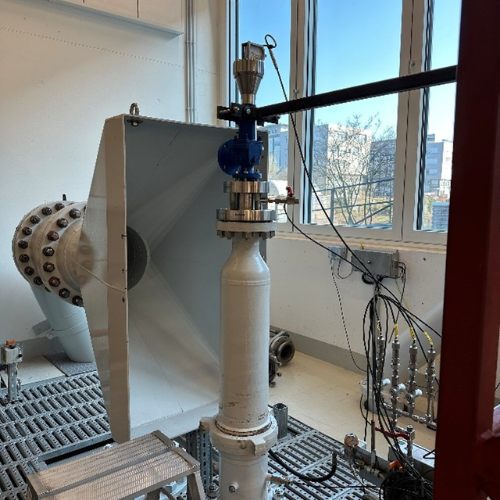
Measuring station. Test set-up at LESER.
Set pressure. Comparing effective surfaces.