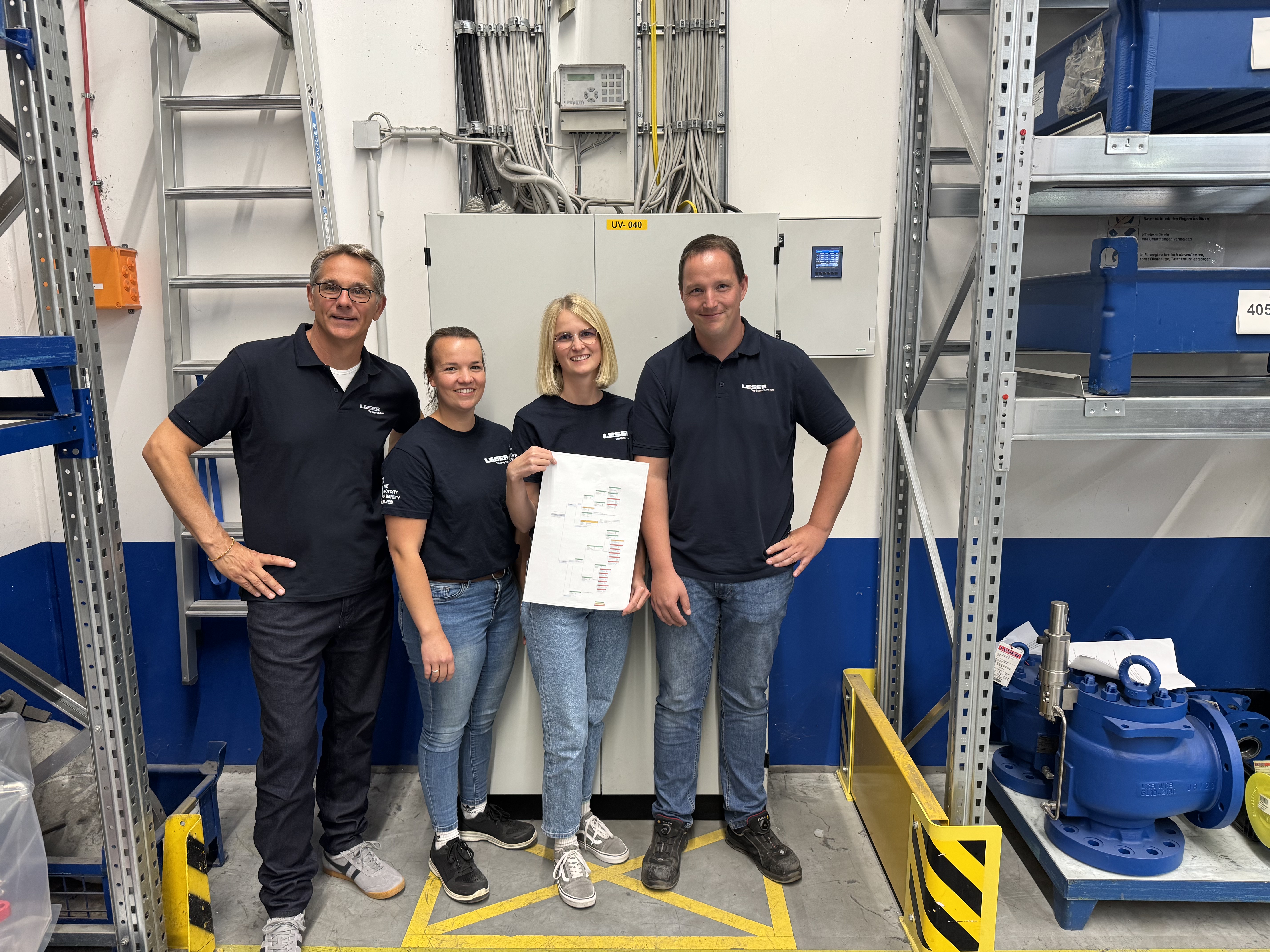
(from left to right) Kai-Uwe Weiß, Corinna Hülsing, Ineke Harms, Thore Söhren. Not pictured: Jörg Windmüller
Certification according to ISO 50001 Energy Management
Investment for Greater Efficiency and Sustainability
For companies in mechanical and plant engineering, sustainability means providing future-proof product solutions and producing them in a resource-efficient way. This also applies to LESER. The company has set itself the goal of becoming CO₂-neutral for direct and indirect emissions by 2035. This does not yet include the upstream and downstream value chain, such as foundries or transport to the customer. Direct emissions arise, for example, from heating systems or the vehicle fleet, while indirect emissions are generated outside the company but are caused by demands such as electricity or district heating.
An important step on this path is the establishment of an energy management system to systematically record, analyze, and make energy consumption visible through monitoring. A milestone in this process was the certification according to DIN EN ISO 50001 for LESER Germany,. However, it was a long journey to reach this point.
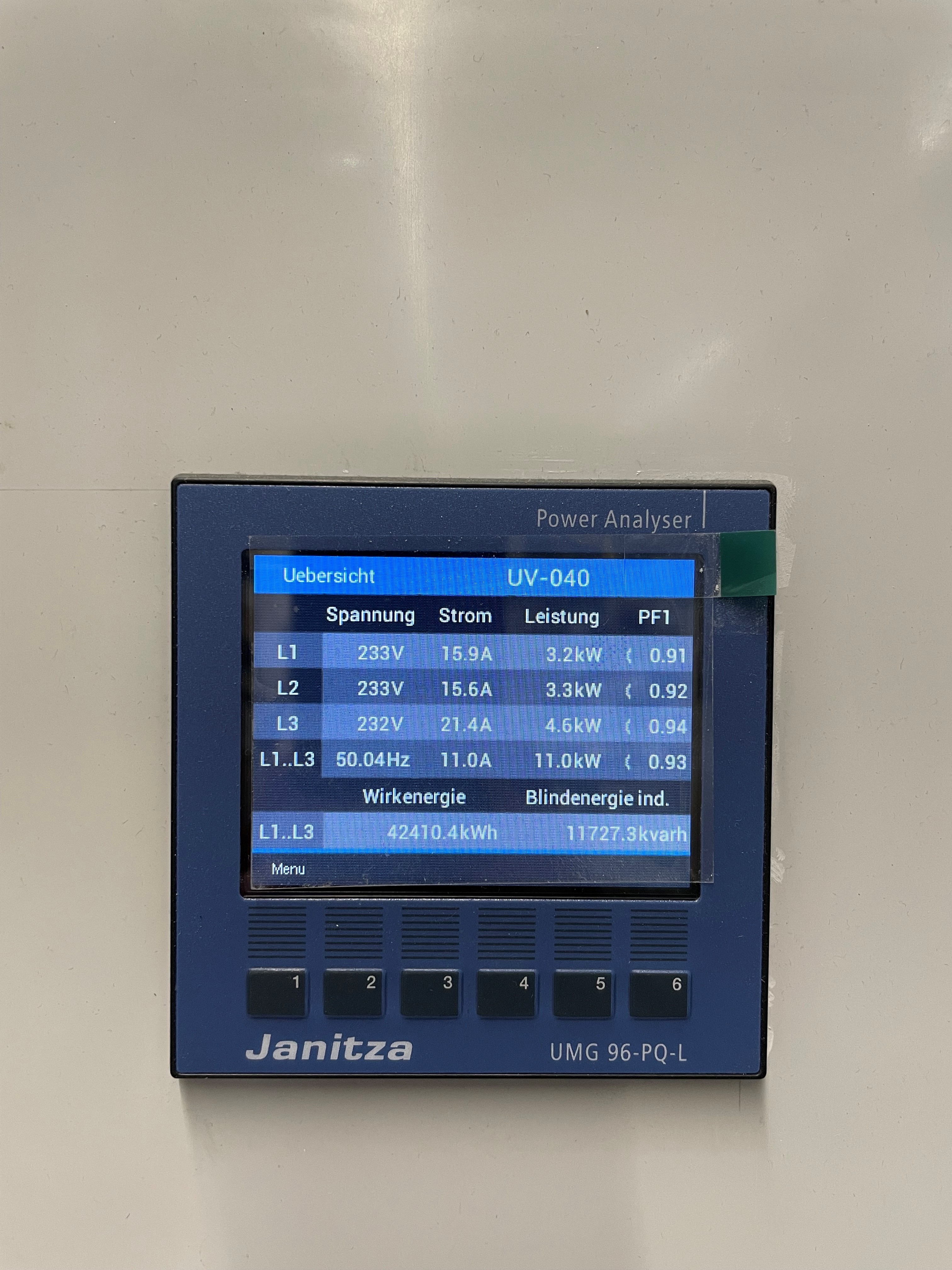
52 Janitza digital electricity meters were installed at the plant in Hohenwestedt
From Concept Phase to Implementation with Investments in Measurement Technology
The starting point in 2024 was the question of which levers have the greatest impact on energy consumption and CO₂ neutrality. One challenge was that although data on total consumption was available at the Hamburg and Hohenwestedt sites, there were hardly any detailed measurements of individual consumers. The project team led by Ineke Harms from Quality Management developed a concept that mapped the existing measurement points. It also identified which additional digital measurement points are required for comprehensive energy monitoring. For this purpose, machines and systems, compressors, air conditioning and ventilation systems, lighting, and server rooms were categorized and grouped.
Based on this concept, LESER invested in modern energy measurement technology, particularly at the Hohenwestedt plant. Around 75% of the total emissions of LESER Germany are generated by electricity consumption in the production plant. A total of 52 electricity meters were installed and retrofitted in 24 sub-distribution units. This measurement infrastructure enables transparent, data-based allocation of consumption to processes and defined groupings.
Tangible Benefits and Long-Term Impact
On this data-driven basis, work began to identify savings potential in detail, reduce operating costs, and align processes accordingly.
“The certification according to DIN EN ISO 50001 is much more than a formal step,” says Ineke Harms. “It is a driver for the continuous improvement of energy efficiency – today and in the future.”